

Japan Visa Renewal Fees Rise October 1, 2026: What Foreign Teachers Need to Know
Updated: August 28, 2026
Japan will introduce significantly higher immigration fees from October 1, 2026, including major increases for extensions of period of stay, changes of residence status and Permanent Residence.
For foreign teachers, a one-year extension will cost ¥33,000 at an immigration office or ¥27,000 online, while a five-year permission will cost ¥75,000 in person or ¥65,0
00 online. Permanent Residence will cost ¥200,000, compared with ¥10,000 under the current system. [1][2][4]
The Japanese government formally approved the implementing decrees on August 25, 2026. On August 28, e-Gov published the result of the public-comment process, confirming that the main implementing regulations had completed that stage. The new fee system takes effect on October 1, 2026. [1][2][3]
For ALTs, eikaiwa instructors, private-school teachers, international-school teachers, university instructors and other foreign educators, here is what you need to know.
Japan Visa Renewal Fees: Before and After October 1, 2026
Until September 30, 2026, the standard fee for an extension of period of stay or change of status is ¥6,000 at an immigration office (¥5,500 online). From October 1, the fee will depend on the period of stay granted. Figures in brackets below show the online application fee. [4][5]
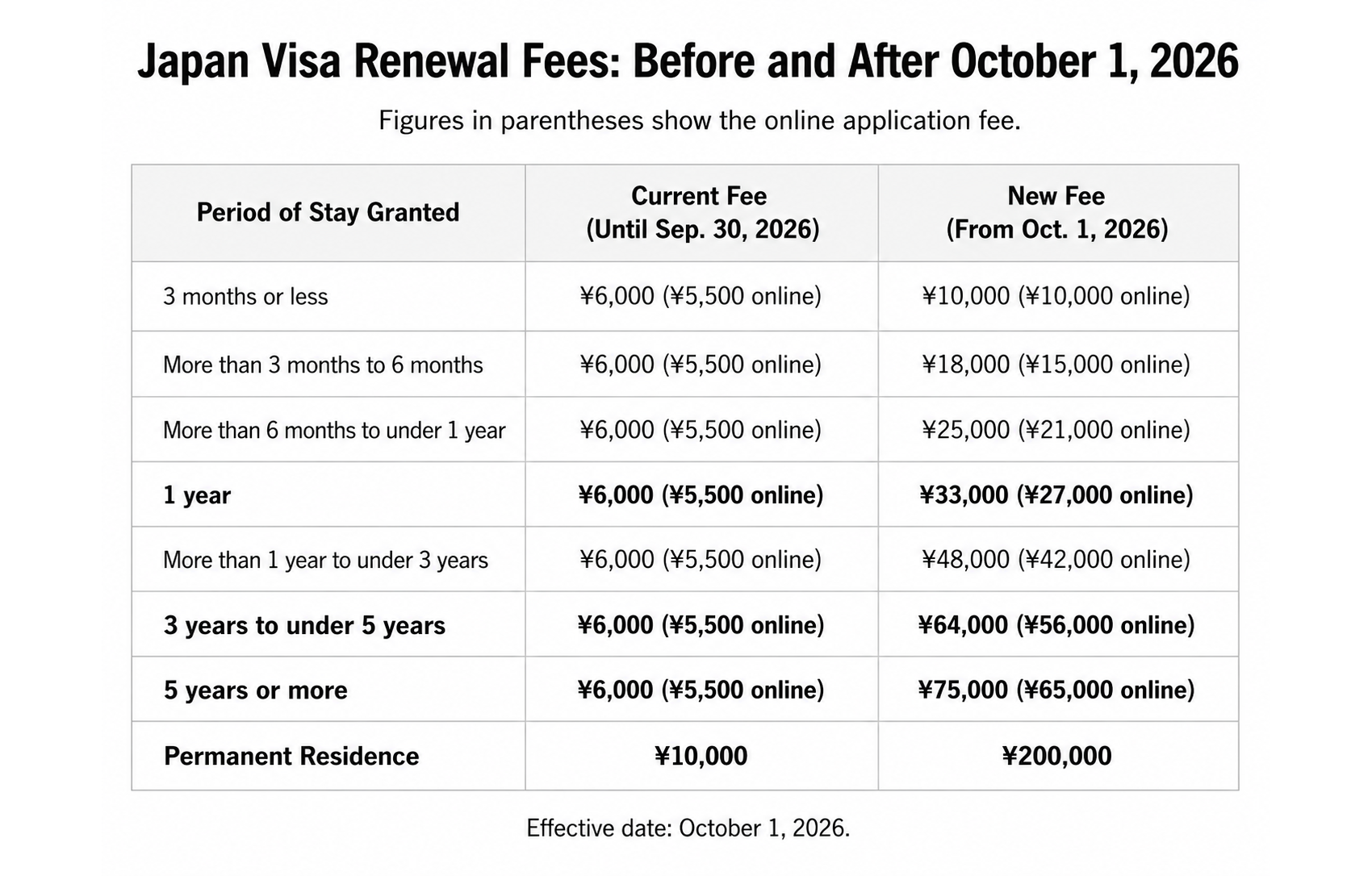 Dates: Current fees apply until September 30, 2026. The new fee system takes effect on October 1, 2026. Figures in brackets are online application fees. Permanent Residence is shown separately because it is a permission fee rather than a standard renewal fee.
This Is No Longer Just a Proposal
Earlier in 2026, the detailed amounts were correctly described as proposed because the implementing regulations were still going through the government process.
That process has now advanced much further.
On May 29, 2026, the Diet passed the 2026 amendment to the Immigration Control and Refugee Recognition Act. The law was promulgated on June 5 as Act No. 32 of 2026. It raised the legal ceilings for status changes and extensions to ¥100,000 and for Permanent Residence to ¥300,000, while leaving the exact amounts to be set by government order. [7]
On July 3, the Immigration Services Agency published the detailed fee schedule for public comment. On August 25, the Cabinet formally approved the relevant commencement-date decree and the decree amending the Immigration Control Act Enforcement Order. [1][4]
On August 28, e-Gov published the result of the main public-comment case. It recorded 6,175 submitted comments for case 315000136. [3]
The clearest wording now is: Japan’s new immigration fee system takes effect on October 1, 2026, following approval of the implementing decrees in August 2026.
“Visa Renewal” Is the Common Term — but Technically It Is a Period-of-Stay Extension
Foreign residents often call the process a “visa renewal.” Technically, once you are living in Japan, the relevant immigration procedure is usually an Extension of Period of Stay (在留期間更新許可), rather than renewing an entry visa. [6]
The same fee structure also applies to a Change of Status of Residence (在留資格変更許可). So if you change from one eligible residence status to another because your job or circumstances change, the new fees may also apply.
What Does This Mean for English Teachers in Japan?
The change is especially relevant to teachers because common teaching residence statuses can be granted for one, three or five years. Depending on the job, foreign teachers may hold statuses such as Instructor (教育) or Engineer/Specialist in Humanities/International Services (技術・人文知識・国際業務).
The new fee is based mainly on the period of stay granted, not whether you are an ALT, eikaiwa instructor, private-school teacher or international-school teacher.
If You Receive a One-Year Period
Current in-person fee: ¥6,000
New in-person fee from Oct. 1: ¥33,000
New online fee from Oct. 1: ¥27,000
For teachers who repeatedly receive one-year periods, a routine renewal becomes a much more noticeable expense.
If You Receive a Three-Year Period
Current in-person fee: ¥6,000
New in-person fee from Oct. 1: ¥64,000
New online fee from Oct. 1: ¥56,000
Compared with the current standard in-person fee, the increase is ¥58,000.
If You Receive a Five-Year Period
Current in-person fee: ¥6,000
New in-person fee from Oct. 1: ¥75,000
New online fee from Oct. 1: ¥65,000
The new in-person fee is more than 12 times the current ¥6,000 fee.
Important: The Fee Is Based on the Period Immigration Grants You
You do not simply choose to pay the one-year, three-year or five-year fee. The relevant amount is tied to the period of stay Immigration grants when it approves the application. [4]
For example, if you hope to receive a five-year period but are granted three years, the three-year category applies. Two teachers doing similar jobs can therefore end up paying different fees if they are granted different periods of stay.
Permanent Residence Will Cost ¥200,000
The biggest single increase is for Permanent Residence (永住許可).
Current fee until September 30, 2026: ¥10,000
New fee from October 1, 2026: ¥200,000
That is 20 times the current amount.
The current Immigration Services Agency procedure treats the PR charge as a permission fee, payable when Permanent Residence is granted. [5]
For teachers who have lived in Japan for many years and are considering PR, the new ¥200,000 fee is worth including in long-term financial planning.
This article focuses specifically on immigration fees. Japan is also changing other aspects of the Permanent Residence system, but those reforms have separate rules and implementation dates and should not be confused with the October 1 fee change.
Why Is Japan Raising the Fees So Much?
The Immigration Services Agency published explanatory material showing how it developed the new amounts. For a status change or extension, it estimated the direct cost of examining an application at roughly ¥10,000, including personnel, systems and administrative expenses. [4]
The government also included what it describes as a benefit-related element connected with immigration and residence administration and considered immigration charges in several other countries. [4]
For Permanent Residence, the government material calculated approximately:
- ¥20,000 in examination costs;
- ¥180,000 as the additional benefit-related element.
Together, those components produce the ¥200,000 Permanent Residence fee. [4]
Online Applications Will Be Cheaper
For most periods longer than three months, online applications will cost less than applying at an immigration counter. The Immigration Services Agency says the difference is intended to encourage online use, improve convenience and reduce congestion. [4]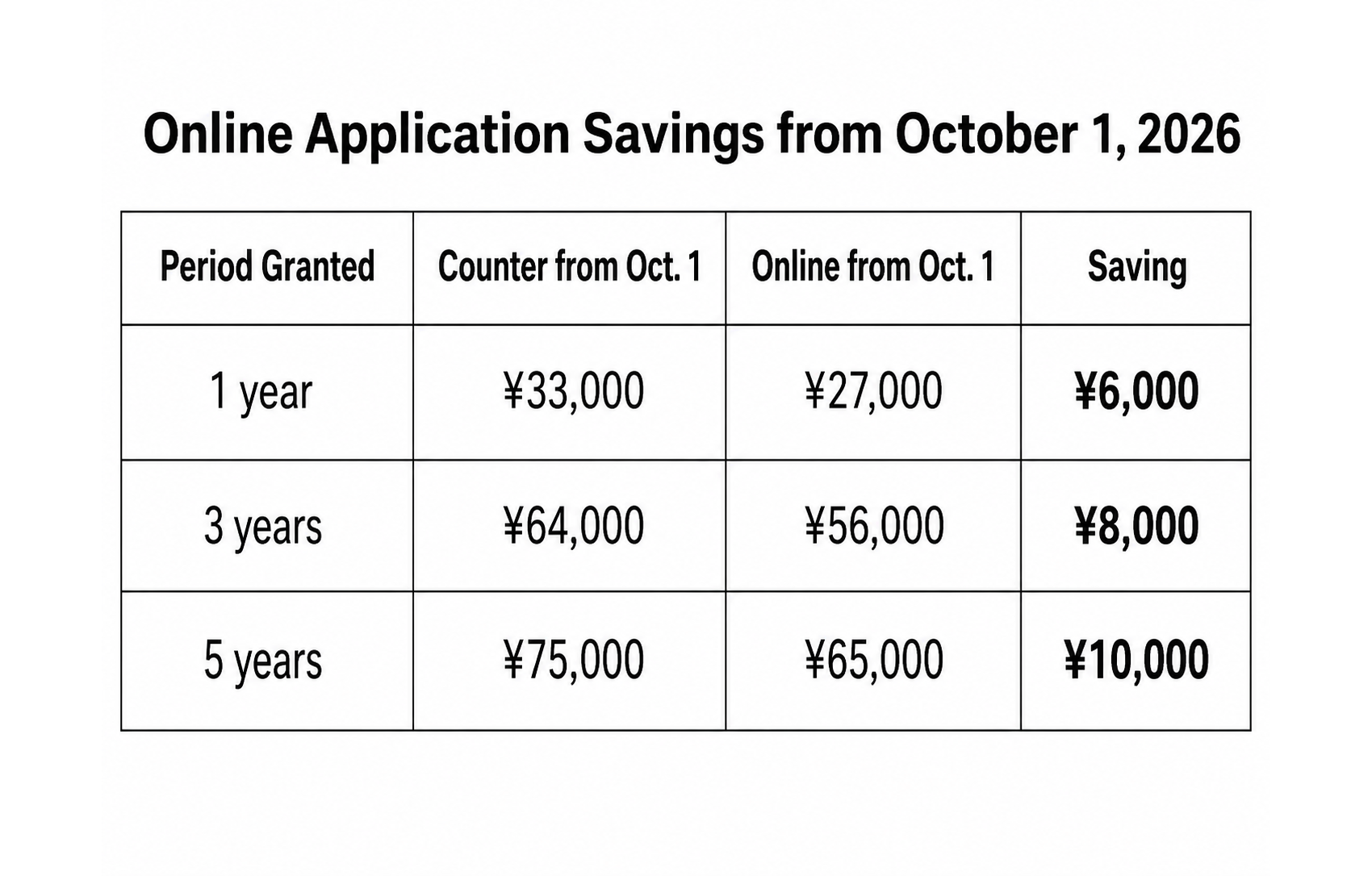 For eligible teachers, the online residence-application system could therefore become considerably more attractive after October.
Can You Renew Early Before October 1?
This is likely to be one of the biggest questions for teachers whose residence cards expire around autumn 2026.
Under the Immigration Services Agency’s normal rules, a person with a period of stay of six months or longer can generally apply for an extension from around three months before the expiry date. Earlier filing may be possible in special circumstances. [6]
Do not assume that filing before October 1 automatically guarantees the old fee.
When Japan increased immigration fees in April 2025, the Immigration Services Agency published a specific transitional rule for applications accepted before the change. [5]
For the October 2026 change, anyone whose application falls close to the transition date should check the latest Immigration Services Agency guidance rather than assuming the previous transition rule will apply in exactly the same way.
Are There Any Fee Reductions or Exemptions?
Yes, but ordinary foreign workers should not assume that they qualify.
The government materials provide exemptions for certain Diplomatic and Official status cases and limited reductions for specified humanitarian or serious financial-hardship situations. [4]
Qualifying cases may receive reductions of up to ¥10,000 for certain status changes or extensions and up to ¥20,000 for Permanent Residence. These are targeted exceptions, not a general discount for lower-paid workers. [4]
An ordinary ALT or eikaiwa teacher should therefore budget on the basis of the standard fee unless Immigration confirms that a reduction or exemption applies.
Timeline: How We Got Here
May 29, 2026 — Diet passes the law
The 2026 immigration-law amendment was passed by the Diet. [7]
June 5, 2026 — Law promulgated
The amendment was promulgated as Act No. 32 of 2026. It raised the statutory fee ceilings while leaving the exact amounts to government order. [7]
July 3, 2026 — Detailed fees published
The Immigration Services Agency opened the implementing regulations for public comment and published the detailed fee schedule. [4]
August 3, 2026 — Public comment closes
The public-comment period for the main implementing regulations ended. [3]
August 25, 2026 — Cabinet approves implementing decrees
The Cabinet approved the commencement-date decree and the decree amending the Immigration Control Act Enforcement Order. [1][2]
August 28, 2026 — e-Gov publishes the result
e-Gov published the result of case 315000136 and recorded 6,175 submitted comments. [3]
October 1, 2026 — New fees take effect
The new immigration fee system takes effect. [1][2][4]
What Foreign Teachers Should Do Now
✅ Check the expiry date on your residence card. If your status expires in late 2026, find out when you are eligible to submit your renewal.
✅ Budget for the new fee. A one-, three- or five-year renewal could cost substantially more than before.
✅ Check whether online application is available to you. The savings can reach ¥10,000 compared with applying at an immigration counter.
✅ Do not assume you can choose your fee by requesting a particular period. The amount depends on the period Immigration actually grants.
✅ If your application crosses the October 1 transition, check the latest ISA guidance rather than relying on rumors.
✅ If you are considering Permanent Residence, plan for a ¥200,000 permission fee from October 1, 2026.
Frequently Asked Questions
Are Japan visa renewal fees really increasing on October 1, 2026?
Yes. The underlying law has been enacted, the Cabinet approved the implementing decrees on August 25, and the new fee system takes effect on October 1, 2026. [1][2][7]
How much will a one-year Japan visa renewal cost?
From October 1, a one-year period will cost ¥33,000 at an immigration office or ¥27,000 online. [4]
How much will a three-year renewal cost?
A period of three years or more but under five years will cost ¥64,000 in person or ¥56,000 online. [4]
How much will a five-year renewal cost?
A period of five years or more will cost ¥75,000 at the counter or ¥65,000 online. [4]
How much will Permanent Residence cost?
Permanent Residence permission will cost ¥200,000 from October 1, compared with the current ¥10,000 fee. [4][5]
Does this only affect English teachers?
No. The system applies more broadly to foreign residents extending their period of stay or changing residence status. This article focuses on teachers because these procedures are a routine part of working long-term in Japan.
Is an online application cheaper?
Usually, yes. For periods longer than three months, the new online fee is generally lower than the counter fee. [4]
Can I renew three months early?
If your current period of stay is six months or longer, applications are generally accepted from around three months before expiry. Check the latest ISA guidance for any transition-specific fee rule. [6]
Bottom Line for Foreign Teachers in Japan
For years, the cost of renewing a residence status in Japan has been relatively small. From October 1, 2026, that changes significantly.
A foreign teacher who currently pays ¥6,000 at an immigration office could face:
- ¥33,000 for a one-year period
- ¥64,000 for a three-year period
- ¥75,000 for a five-year period
Online applications will generally be somewhat cheaper. For long-term residents, the biggest increase is Permanent Residence: ¥200,000 instead of the current ¥10,000. [4][5]
This is no longer merely an early proposal.
The underlying law has passed, the Cabinet approved the implementing decrees on August 25, and the public-comment result was published on August 28. The new fees take effect on October 1, 2026. [1][2][3][7]
Foreign teachers with renewals approaching should check their residence-card expiry dates now, consider online filing where eligible, and follow Immigration Services Agency guidance for any transition instructions affecting applications around October 1.
Looking for Your Next Teaching Job in Japan?
A visa renewal is only one part of building a career and life in Japan.
SenseiJob helps foreign teachers discover teaching opportunities and stay informed about the issues that affect working in Japan.
✅ Teaching jobs in Japan
✅ ALT and school opportunities
✅ Eikaiwa positions
✅ Career information for foreign teachers
✅ Teacher experiences and advice
✅ Practical updates about working and living in Japan
Find teaching jobs on SenseiJob
Join the SenseiJob Teacher Community
SenseiJob on YouTube — Teacher Advice & Experiences
Join the SenseiJob Foreign Teacher Facebook Community
Join the SenseiJob Professional Teacher Network on LinkedIn
Looking for your next teaching opportunity in Japan? Explore SenseiJob and connect with other teachers building their careers in Japan.
Official Japanese Government Sources
[1] Prime Minister's Office of Japan (首相官邸) — Regular Cabinet Meeting Items, August 25, 2026. Lists the decree setting the commencement date and the decree amending the Immigration Control Act Enforcement Order as Cabinet decisions.
View the August 25 Cabinet decisions
[2] Ministry of Justice — Minister of Justice press conference, August 25, 2026. Confirms that the Cabinet approved the relevant decrees and discusses formal determination of the fee system following public comment.
View the Ministry of Justice press conference
[3] e-Gov Public Comment / Immigration Services Agency — Result notice for case 315000136, published August 28, 2026. Records 6,175 submitted comments on the main implementing regulations.
View the e-Gov public-comment results
[4] Immigration Services Agency of Japan / e-Gov — Official residence-permission fee material showing the detailed fee schedule, Permanent Residence fee, online fees, and reduction/exemption framework.
View the official fee materials
[5] Immigration Services Agency of Japan — Current residence-procedure fees, including ¥6,000 in person, ¥5,500 online, and ¥10,000 for Permanent Residence under the current schedule.
View current ISA fee information
[6] Immigration Services Agency of Japan — Application for Extension of Period of Stay. Explains the renewal procedure and general application timing.
View the official extension procedure
[7] Immigration Services Agency of Japan / Ministry of Justice — 2026 Amendment to the Immigration Control Act. Confirms passage, promulgation, and higher statutory fee ceilings.
View the 2026 immigration-law amendment
This article is for general informational purposes and does not constitute individual immigration or legal advice. Immigration procedures and transition arrangements can be updated. Always confirm the latest requirements for your own application with the Immigration Services Agency of Japan or an appropriately qualified immigration professional.